

You were lying in bed last night when a great idea popped into your head. It was so simple you felt stupid that you hadn't thought of it before: a way to improve your Google Ads. Good times are here again.
You couldn't wait to tell your boss or client. You proudly told them the next day and made the changes. In your head you'd just scored the winning goal.
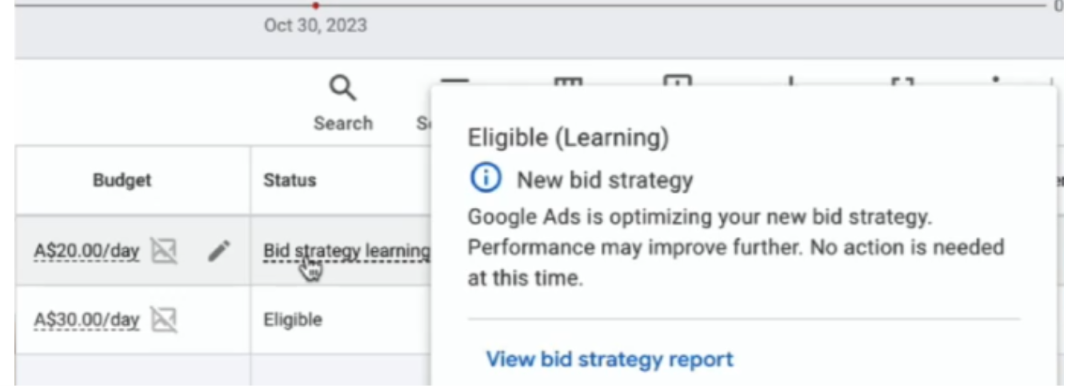
Then you see it. A little "Learning" label next to the bid strategy. And now you're scared to touch anything in case you break it.
Kenny Rogers had it right. The whole game is knowing when to hold and when to fold.
Most advice treats the Google Ads learning phase like a sleeping baby. Don't make a sound, don't open the door, just wait.
Some of that is right. But a lot of it is out of date, and some of it will cost you money.
What the Google Ads learning phase actually is
• When you use Smart Bidding (Maximise Conversions, Maximise Conversion Value, Target CPA or Target ROAS), Google sets your bids based on how likely each search is to convert. When you change something important, it needs time to recalibrate.
• Think of it like a sat nav. You change the destination and it says "recalculating". It hasn't forgotten how roads work. It just needs a minute to work out the new route.
• Manual CPC doesn't have a learning phase. You're the sat nav.
What triggers it
Google rewrote its help page on this in October 2026, and it's much clearer now. There are three triggers:
1. A new strategy. You've created a bid strategy, switched to a new one, or turned a paused one back on.
2. A composition change. You've added or removed campaigns, ad groups or keywords.
3. A goal change. The conversion goals or actions you're optimising for have changed significantly.
Applying a new portfolio bid strategy counts too. A portfolio strategy is one bid strategy shared across several campaigns, so they pool their data and chase the same target. Moving campaigns onto a new one is like going from driving on your own to leading a convoy. The sat nav now has to get three cars there instead of one, so yes, it recalculates.
Even when you switch strategy, Google says it doesn't start from scratch if you have conversion history. It uses what it already knows.
What doesn't trigger it
This is the bit that surprises people. According to Google, these don't put you back into learning:
• Budget changes
• Changing your target CPA or target ROAS
• Location or audience targeting changes
• New or edited ads and assets
That doesn't mean they do nothing. Change your target ROAS and performance will still shift. It just won't show the label, and it doesn't wipe the slate.
And the old "never change your budget by more than 20%" rule? It isn't on Google's page. Treat it as pub wisdom.
How long it lasts
The Learning label never lasts more than seven days. That's Google's own wording.
But the label going away doesn't mean the campaign has settled. Google says performance usually settles within one to two conversion cycles.
So what's a conversion cycle?
It's the time between someone clicking your ad and actually buying or getting in touch.
For a takeaway, that's about ten minutes. You're hungry, you search, you click, you order. Done before the kettle's boiled.
For a kitchen fitter, it's a different story. Someone clicks your ad on a Sunday night, looks at your photos, sends the link to their partner, gets two other quotes, argues about worktops, and finally fills in your form three weeks later. That's a three week conversion cycle.
This matters because Smart Bidding learns from conversions. If your customers take three weeks to decide, Google won't know whether last Monday's clicks were any good until three weeks after last Monday. Judging the campaign after a few days is like marking an exam before the students have finished writing.
You can check yours in Google Ads by looking at days to conversion in your conversion reports. Most accounts are surprised by how long it is.
Google's advice is to judge performance over two conversion cycles or two weeks, whichever is longer. So for the takeaway, two weeks. For the kitchen fitter, six.
You'll still see people quoting 50 conversions as the magic number. That figure appeared in earlier versions of Google's guidance, but it isn't on the current page. More data still helps. There's just no official finish line.
When to protect it
• If your tracking is right and your goal is right, leave it alone.
• Don't add five ad groups on Tuesday and pull two out on Thursday. Every composition change hands the system a new problem to solve, and you're paying for the lessons.
• Batch your changes. Make them once, then wait out the cycle.
When protecting it is a mistake
This is the real reason I wanted to write this.
I recently helped someone running Google Ads for an online olive oil shop. Their campaign had just come out of learning and they were nervous about changing anything.
The problem? Add to Cart was set as a primary conversion alongside Purchase. Google Ads was reporting 36 conversions. GA4 showed 2 purchases from paid search.
So the campaign had spent two weeks getting very good at finding people who put olive oil in a basket and then wandered off.
Protecting that learning is like refusing to touch the sat nav because it's finally stopped recalculating, when you typed in the wrong postcode. The route is lovely. It's just taking you to the wrong place.
When the data going in is wrong, the learning is wrong. Fix the goal and accept the reset. A week of recalibration is cheaper than months of optimising toward the wrong thing.
The same goes when there isn't enough data. Two purchases in two weeks gives Smart Bidding almost nothing to work with. In that situation I'd drop back to Max Clicks with a CPC cap, or Manual CPC, until purchases build up. Then bring Smart Bidding back in.
A quick checklist
Before you change a Smart Bidding campaign, ask:
• Is my primary conversion the thing I actually care about?
• Do the numbers match real orders or real leads?
• Am I getting enough conversions for the system to learn from?
• Can I make all my changes in one go?
If the first three are yes, make your changes together and leave it alone for two conversion cycles.
If any of the first three are no, fix that first. The learning phase can wait.
Not sure which side of the line you're on?
If your campaigns are stuck in a loop of learning, tinkering and learning again, I can help. I'll look at your account and tell you straight whether your learning phase is worth protecting, or whether it's just protecting a mistake.
Get in touch for a chat. No hard sell, just an honest look at what's going on.
References
Google Ads Help, About Smart Bidding learning: https://support.google.com/google-ads/answer/13020501?hl=en-GB
Miraflow, Smart Bidding learning period changes (2026): https://miraflow.ai/blog/google-ads-smart-bidding-learning-period-7-day-limit-2026
TechWyse, Google Ads updates Smart Bidding documentation: https://www.techwyse.com/news/platform-updates/google-ads-smart-bidding-learning-period-50-conversions
